What’s The Importance Of Functional Training?
Are you ready working out for real life situations?
More and more people are using functional training…some argue it’s the only way to train for real results.
Functional – Func.tion.al:
1. capable of operating or functioning
2. capable of serving the purpose for which it was intended (Webster’s Encyclopedia 2nd Edition, 1996)
Functional training is often referred to as functional exercise…
The common theme for functional exercise is any workout which adapts or develops exercises.
Exercise to perform activities for sport or everyday life more easily while reducing risk of injury.
The truth is, even if you can lift heavy at the gym and you can do 20 minutes of high-intensity interval training every other day…
Does it mean the next time you lift a 65 pound suitcase on your way to airport you won’t throw your back out?
Human movement cannot take place without muscular function…
According to functional training experts…
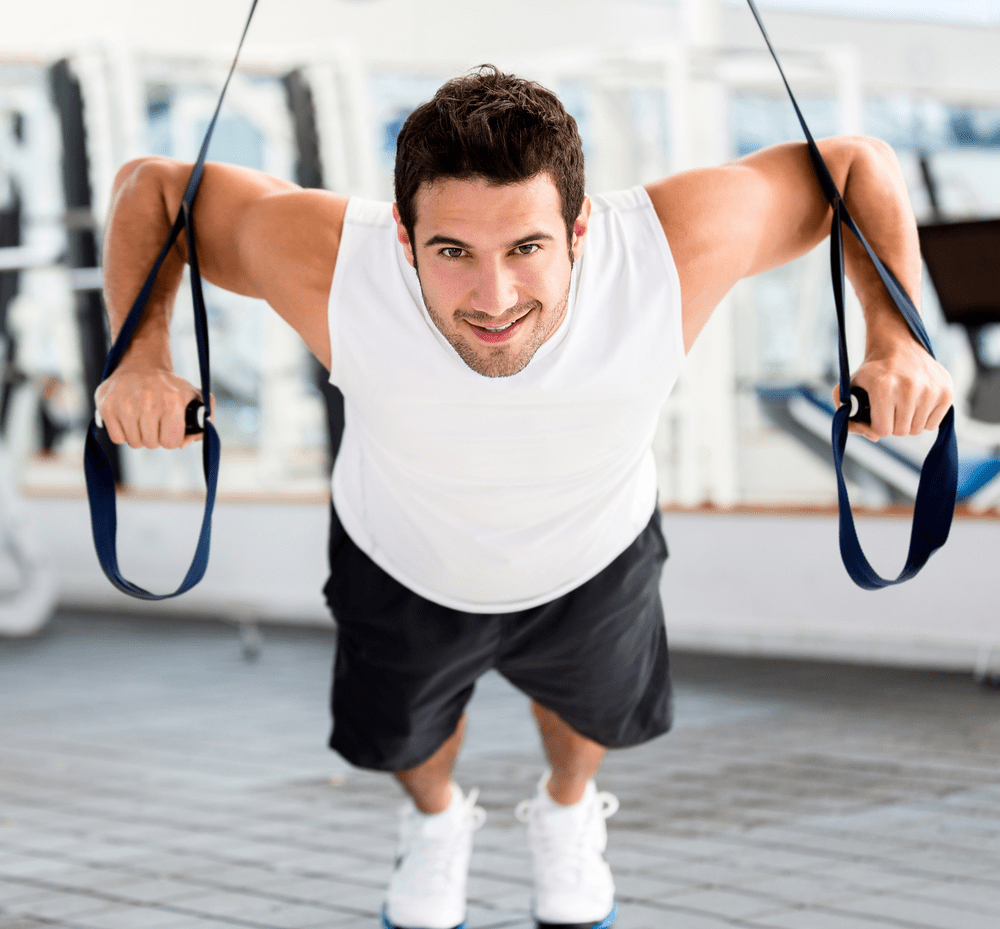
Functional training uses bands, balls, free-weights and plyometric exercises in an attempt to condition the body in an unstable environment.
Many of the experts feel that performing exercises which mimic activities or specific skills is the most effective way to train…regardless of the goal.
What is the safest, most efficient and effective way to optimize human performance?
Functional fitness focuses on training in a “smart way” so your body can handle day to day real life activities.
For example…functional strength
If you break this down to its simplicity…like lugging groceries, picking up kids, etc…
So, instead of focusing on lifting a certain amount of weight or proper form of a particular exercise, functional fitness focuses on functional strength and improvements in becoming better at real life situations.
And to perform every day activities better with functional strength.
Muscles Working Together
Your typical weight training or strength training workout isolates specific muscles, right?
However these profile of exercises neglects to train the body to use compound or multiple muscle groups together…
Functional exercise does integrate different muscles via proper form.
Just know this type of natural motion teaches your muscles and body to work together.
This yields overall fitness so the entire body is working in unison.
Finding Balance via Core Stability
While many focus on weights, weight machines and compound exercises, they neglect to address a fundamental need we humans have for day to day life and that is balance.
Balance training exercises, like the one legged squat is more useful for everyday life than leg pressing 500 pounds.
Why?
Because core stability is what serves you in everyday life, like when you have to reach for something in a high cabinet or walking up and down stairs.
Balance is an integral part of everyday life, including, regular tasks of walking, using the stairs and reaching for something, but, it goes beyond that.
Did you know that a balance system that functions properly can help humans to see clearly while moving, orient themselves in terms of gravity, assess direction and speed of movement…
And allows them to make adjustments to posture and stability while doing daily activities.
Training your body to control and balance its own weight can serve you when you are young and as you age.
It makes you stronger, more “core stability” and therefore allows you to avoid falls, which are some of the most common injuries seen in seniors.
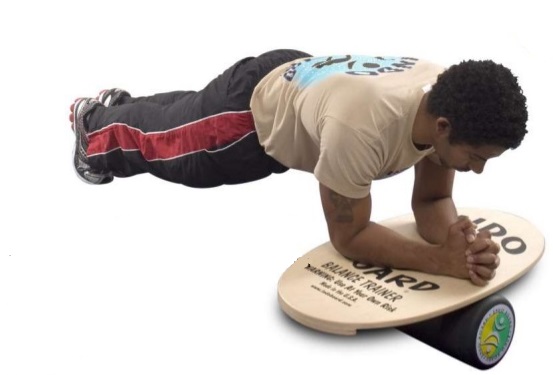
Functional training for improved core stability
According to the Centers for Disease Control and Prevention, 1 in 3 adults age 65 or older suffer a fall that results in moderate to severe injuries.
This includes debilitating hip fracture or very serious head trauma which can increase the risks of early death.
Avoiding Compensation
One of the drawbacks of typical strength training workouts is that they leave isolated weakness in the body that then becomes detrimental in day to day movement.
While you strengthen certain muscles, like the arms and shoulders, you may inadvertently neglect to train others and that creates a pattern of compensation…
Simply this means when you use them together to perform daily activities one works harder than the other and that type of strain can cause injury.
Functional exercises teach isolated muscles to work together.
Ideally when you pick up a suitcase or your child or reach for something on a high shelf you won’t tweak a weak muscle that is not properly trained.
Workouts which include:
- bending
- pushing
- pulling
- lifting
- sitting
- reaching
- balance
- twisting…
And those workouts and movements which mimic day to day life, engage core muscles, while at the same time targeting other muscles of the body providing an overall “functional” state of fitness.
There Is More
Functional training goes beyond the above to mitigate bone loss through movements that support body weight and that helps to prevent osteoporosis.
The multi-joint, multi-plane movements engage the body’s stabilizers that help to improve coordination, challenge the brain and ultimately serve you to cope with your day to day activities to become more functional.
Components Of Functional Workouts
There are several elements to functional workouts that make them that much more effective.
These need to be adapted to each individual’s goals and needs:
• The workouts should be directed toward one’s specific everyday life activities.
• Individualized programs that tailor to the specific goals and needs of an individual.
For example, specific exercises that are made for someone age 60 who wants to avoid falls…
Any adult looking to improve their day to day activity performance or an athlete training in a specific sport.
And someone who is in physical therapy and retraining their body.
No matter the circumstance, the workouts should focus on meaningful tasks:
• The overall state of health of the individual should be considered when assessing the types of exercises to use and the overall training load.
• There should be a well-integrated program that includes power, strength, balance, and core exercises that focus on multiple movement planes.
• The training should progress with increasing difficulty.
• The training should include varying tasks.
• Functional training should be repeated regularly on an ongoing basis.
• Feedback as to progression is needed either through self-assessment or the assessment of a trainer or physical therapist.
Examples Of Functional Exercises
• Any exercise that involves standing on two feet and supporting yourself while lifting any type of weight is typically a functional exercise.
You can really do this at home just by repeating activities that mimic the above.
• Balance Exercises – Various balance exercises without weights that teach the body to stabilize itself.
• Exercise Ball – The greatest benefit to training using ball exercises is that they target the core muscles that are vital for stability and good posture.
There are many different moves with the ball…
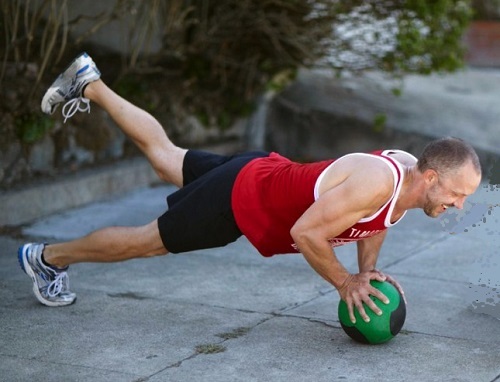
• BOSU Ball – As opposed to the exercise ball, a BOSU has a round side and a flat side.
The BOSU makes any exercise a lot more challenging because it adds an element of instability to each workout as it forces you to use the core to remain steady.
BOSU workouts focus to improve strength and help muscles learn to work together that prevents injury in real life.
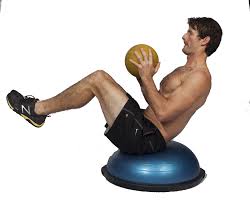
• Bent Over Row – works the back, shoulder and arm muscles and mimics life activities.
Think about bending over to make the bed, a mechanic bending to repair a car, a carpenter bending over a saw table, bending over to plug in electronics, even bending down to get something from a low shelf and many more.
Much more useful when compared to a seated row, where you are only working the chest and arms.
And your body is not activating its core stabilizer muscles…
It is not training to use those muscles together because the machine is doing most of the stabilization work:
• Stand On One Leg (you can start by holding onto a chair at first, then work to doing it on your own)
• One Legged Squat
• Lift Off
• Single Leg Deadlift
• Medicine Ball Squat With Overhead Lift
• Medicine Ball Reach
• Multidirectional Lunges
• Standing Bicep Curls
• Step-Ups With Weights
• Dumbbell Lunge
• Lunge With Back Row
• Deadlift
• Powerclean
• Overhead Press
• Front Squats
• Chin Ups and Pull Ups
• Kettlebell or Dumbbell Swing
• Planks
• Many more
How To Get Started With Functional Fitness
The truth is that functional exercises, like other full body workouts are more difficult than machines, as they are more demanding on the body.
If you are over 40 or have health problems you should check with your doctor before starting functional or any other exercise program.
Women that are pregnant should check with their doctors as well.
When starting functional training it’s best to begin with bodyweight exercises instead of using weights.
You can add weights as you get more fit because they add resistance and challenge your body.
Those who are experienced fitness buffs can certainly engage in intermediate and advanced level moves in functional training.
These types of exercises can be added into a regular workout routine.
It’s important to note that many functional moves have other benefits and target other fitness goals:
- Strength training
- Fat burning
- Heart health
So choosing a specific functional exercise in lieu of say using a weight machine kills two birds with one stone.
It is important to learn proper form, and there are lots of videos and resources online that can help.
Hiring a personal trainer to teach you basic moves is another great way to get started.
Personal trainer can be very helpful showing you proper form, also creating a customized workout plan based on your needs and lifestyle.
Final Thoughts…
It is never too late to get started with improving your stability and balance that will serve you in your everyday life.
Get functional, stay strong…get started today!
References
1. Schmidt, R. A : Motor Learning and Performance – >From Principles to Practice. Human Kinetics Books; Champaign , IL 1991
2. Bryzcki, Matt : A Practical Approach to Strength Training, Masters Press; Indianapolis , IN 1995
3. Magil, R : Motor Learning – Concepts and Application, 4th Edition, C. Brown Publishing, Madison , Wisconsin 1993
4. Chek, Paul : What is Functional Exercise? (Article), C.H.E.K Institute
5. Calais-Germaine, Blandine : Anatomy of Movement, Easterland Press, Seattle , WA 1993
6. Tortora, Gerard, J : Principles of Human Anatomy, 5th Edition, Harper Collins Publishers, New York , NY 1989
7. Stein, Alan : Improving Athletic Power (Article), Hard Training Newsletter
8. Manny, Ken : Skill Development : An Open and Closed Case (Article) www.naturalstrength.com
9. Kielbaso, Jim : Plyos – My Story (Article) www.cyberpump.com